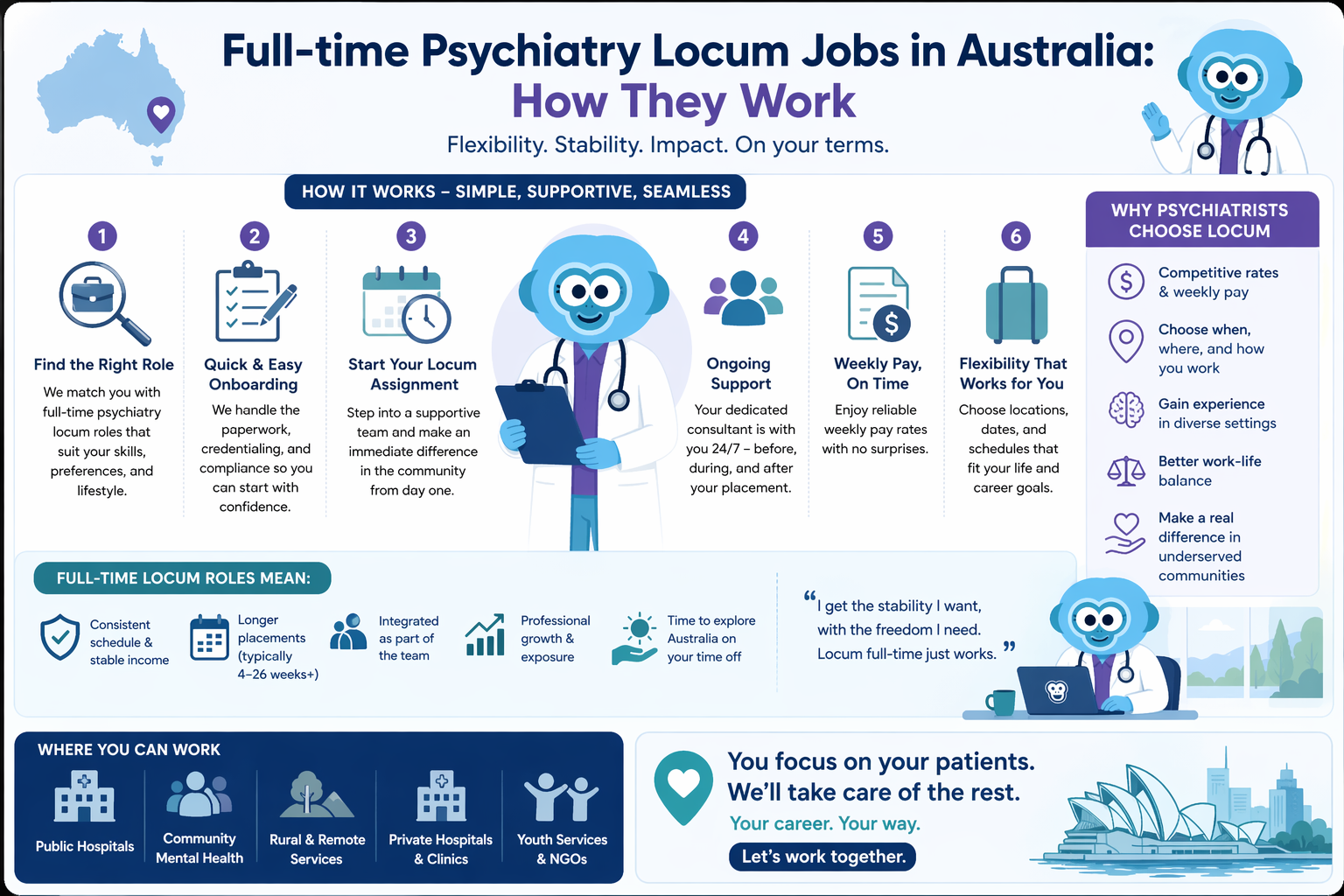
Full-time psychiatry locum jobs in Australia: how they work
Full-time psychiatry locum jobs in Australia: how they work

When most people hear the word locum, they picture a doctor picking up the odd shift here and there.
In psychiatry, that is often not the reality at all.
Across Australia, many full-time psychiatry locum jobs are structured more like fixed-term contracts than casual gap-fill work. Instead of scattered shifts, psychiatrists often step into roles for weeks or months at a time, with regular hours, defined responsibilities, and real continuity within a service.
That is one of the reasons psychiatry locum work appeals to so many doctors. It can offer the flexibility of locuming without the chaos people sometimes associate with the word. And from an SEO perspective, it is also a smart fit for Blugibbon, because “psychiatry locum jobs” is already one of the target search terms identified in your marketing research.
Why do full-time psychiatry locum roles exist?
Because many services need more than short-term cover.
Australia’s psychiatry workforce shortage is not a fringe issue. When permanent recruitment stalls, mental health services still need clinics covered, inpatient teams staffed, community lists managed, and patients seen safely. That is where full-time locums come in.
These are not “extra” roles sitting at the edge of the workforce.
In many hospitals and mental health services, full-time locum psychiatrists are part of how the service keeps functioning.
Are full-time psychiatry locum jobs only in rural areas?
No... and that is an important point.
Regional, rural and remote services often have the strongest demand, and they can be especially attractive because they may offer better rates, travel, accommodation, and the chance to experience a different part of Australia without making a permanent move.
But metro services use locums too.
Melbourne, Sydney, Brisbane and Perth all rely on locum psychiatrists at different times, whether for leave cover, service expansion, recruitment gaps, or hard-to-fill vacancies. In practice, that means psychiatrists can often choose between lifestyle-driven regional contracts and more familiar city-based work, depending on what they want their next few months to look like.
Why psychiatrists choose full-time locum work
The answer is usually not just money.
Yes, the earning potential can be strong. Consultant daily rates are often advertised around the $2,000 to $3,500 mark, with registrar and CMO rates below that and some regional contracts climbing higher with on-call or after-hours requirements, based on the examples you shared.
But that is only part of the appeal.
- Consistent income
A full-time block gives you a clear period of work and a clear period of earnings. You are not stitching a month together shift by shift.
- Flexibility without a long-term tie
You can step properly into a service, contribute meaningfully, and still retain control over what comes next.
- Variety
Different models of care, different teams, different patient cohorts, different locations. You can keep growing without feeling permanently boxed in.
- Travel and lifestyle
Many psychiatry locum contracts include travel and accommodation, especially outside the main cities. For some doctors, that means better money. For others, it means a genuine lifestyle reset.
- A low-risk way to test a role
A few months in a service usually tells you far more than a polished job ad ever will. You get to see the team, the workload, the support, the systems, and whether the place actually fits.
The quiet appeal of psychiatry locuming
One of the more interesting things in psychiatry is that full-time locum work does not always replace permanent work. Sometimes it complements it.
A lot of psychiatrists build hybrid careers. They may keep part-time private practice, take on a public locum contract for part of the week, or use locum work to create more breathing room while still earning well. For registrars, it can also be a deliberate pause — a way to step out of the training treadmill for a period, refresh, travel, and come back with a clearer head.
That is part of why psychiatry locuming can feel more sustainable than people expect. It is not always about “escaping” permanent work. Sometimes it is about designing work in a way that fits your life better.
How do you secure a good full-time psychiatry locum role?
This is where doctors can go wrong.
It is easy to be drawn in by the headline rate, the location, or the promise of flexibility. But the best psychiatry locum roles are rarely chosen on the rate alone.
You want to know:
- your preferred state or location
the length of contract you actually want
whether the work is inpatient, community, or mixed
what the on-call expectations really are
how the team is structured
how well supported the service feels
what your minimum acceptable rate is
how flexible the start date needs to be - And then you want a recruiter who can tell you the truth about the job, not just sell you the easiest line.
Because in psychiatry, support and fit matter enormously. You are not just filling a roster gap. You are stepping into a clinical team, a patient group, and often a service that is already under pressure.
Recent Posts